

This page reproduces the CAFI Strategy 2026–2035, Working Draft for Consultation (18 September 2026). Section headings and order follow the document so readers of the Word version can find their place.
Unlocking Large‑Scale Climate, Nature and Development Impact in the Congo Basin
A Mission
A proven platform to reward forest protection, transform rural economies, and deliver verified results at scale.
A Vision
Halt and reverse deforestation in the Congo Basin by rewarding verified forest protection and sustainable rural livelihoods at scale, in line with regional and global forest commitments.
1. Executive Message: A Turning Point for the Congo Basin
The Congo Basin is one of the planet’s last great climate stabilizers. Its forests remove approximately 1.1 billion tonnes of carbon from the atmosphere each year and store an estimated 80 billion tonnes of carbon in forest biomass and peatlands, making the region one of the world’s most important natural climate solutions. Equally important, the Basin acts as a vast hydrological engine, recycling and transporting moisture across Central and East Africa and helping to regulate rainfall patterns across much of the continent, including in regions far beyond its borders. Home to more than 10,000 plant species, including thousands found nowhere else on Earth, the Basin also harbours globally significant biodiversity. Beyond its environmental importance, it sustains the livelihoods of tens of millions of people. Yet forest loss continues year after year, not because forests lack value, but because poverty leaves many people with few viable alternatives.
CAFI’s strategy is anchored in the regional and global commitments that the countries of the Congo Basin and their partners have made together: the Paris Agreement, the Glasgow Leaders’ Declaration on Forests and Land Use and its pledge to halt and reverse forest loss and land degradation by 2030, and the Belém Call to Action. This strategy is CAFI’s contribution to turning those commitments into verified results on the ground building on partner countries’ national development plans and operational domestic investment projects and programmes that deliver climate, biodiversity and livelihood benefits.
For a decade, CAFI has worked with Central African governments, communities and donors to change this reality. That decade has taught a critical lesson: Forests are best protected when the incentives facing households, communities and governments are aligned with the value of keeping forests standing. Because forest benefits are largely public and global while protection costs are local, payments must be direct, meaningful and conditional on verified, additional results on the ground. But such payments only work where policy, planning and institutions can define rights, monitor outcomes, and ensure rewards reach those able to change land-use decisions.
On this basis, CAFI is shifting towards verified results at scale, building on a decade of policy, planning and institutional work, in order to improve its contribution to halting and reversing deforestation in Central Africa. Performance-based finance will grow as a strong new pillar of CAFI’s model, alongside (not instead of) continued support to policy reform, institutions and enabling conditions, which remain essential in their own right.
By 2035, CAFI aims to mobilise USD 2 billion in total finance for the Congo Basin. This figure covers all resources mobilised from all sources combined, including donor contributions, domestic public finance, private investment and, potentially, carbon and TFFF-related finance. CAFI aims to reach approximately 8 million direct beneficiaries, and enrol approximately 3 million hectares in payments for environmental services and related performance-based schemes. CAFI will seek to progressively increase the share of resources flowing directly to farmers, local communities and Indigenous Peoples, with an aspiration of reaching approximately 50 per cent at portfolio level through PES and other direct support mechanisms, while preserving the flexibility required by different national contexts and implementation needs.
USD mobilised from all sources by 2035
direct beneficiaries
hectares enrolled in PES and related schemes
%
aspiration for resources flowing directly to farmers, communities and Indigenous Peoples
CAFI will leverage co-finance, reducing reliance on international public donors over time: regional governments contribute domestic public resources, private companies co-finance investments linked to their value chains, financial markets provide resources through innovative instruments, multilateral development banks and climate funds provide concessional finance, future carbon markets pay for results, and farmers and microfinance institutions co-invest in productive activities. CAFI recognises that this transition will be gradual and uneven: continued international public finance will remain essential throughout the strategy period, and the pace at which domestic and market finance can realistically grow will be discussed and agreed with partner countries.
Beyond financing, CAFI’s comparative advantage lies in its ability to act as a bridge mechanism, supporting policy dialogue, technical assistance, coordination across sectors and institutions, and catalytic investments that prepare countries to access and scale up financing from the TFFF, carbon markets, other international climate funds and responsible private investment. This integrated approach helps countries design, implement and scale complex forest and climate programmes that would be difficult to deliver through funding alone. It is also critical to CAFI’s ambition to move progressively from externally managed projects towards nationally led programmes and nationally managed financing systems that meet international fiduciary, environmental, social, and technical standards.
This document is a strategy, not an operational prescription. Beyond the headline ambitions above, it deliberately avoids detailed numerical targets and percentages: many would rest on assumptions still being tested, and premature precision would constrain the flexibility a ten-year strategy must preserve. Direction, principles and commitments are set here; programme design belongs to country programmes and CAFI Board decisions.
2. The Global Case for Action
Why the Congo Basin Matters
While receiving disproportionately less funding than other tropical forest basins, the Congo Basin is:
- Home to the world’s second-largest tropical rainforest, and the last major tropical forest region that remains a strong net carbon sink.
- The foundation of livelihoods for tens of millions of people.
- The regulator of rainfall across Africa, where agriculture is rainfed and highly sensitive to precipitation change. Losing these forests would worsen food insecurity for millions, increasing conflict, instability and irregular migration.
Yet deforestation continues on a large scale every year, driven primarily by subsistence agriculture, charcoal production, timber extraction and infrastructure expansion. Unlike other tropical regions, forest loss in Central Africa is not mainly driven by large-scale industrial expansion, but by local livelihood strategies shaped by low rural incomes, weak market access, limited productivity growth and insecure land and resource rights, all of which are incentives that make forest conversion the rational short-term choice. A smallholder clearing a hectare of forest captures only a tiny fraction of the climate value that hectare holds for the world. A smallholder farmer clearing one hectare of tropical rainforest earns around USD 100 per year from growing cassava, while emitting 1,000 tons of CO₂ which could be valued at USD 10,000.
This imbalance defines both the problem and the solution. Where the private returns to clearing exceed the private returns to conservation, forests will remain at risk. But because the opportunity costs of avoiding deforestation are often relatively low, the equation can be changed: forest protection, higher-productivity farming, and sustainable land-use practices can be made more rewarding than continued forest conversion.
3. CAFI's Theory of Change
A decade of foundations
Since 2015, CAFI has grown into the largest forest-climate finance platform dedicated to the Congo Basin, with a continental network of international and local partners and deep partnerships with governments. CAFI broke the isolation of the forest and environment sector, bringing climate and biodiversity into the mainstream development agenda through a platform that connects forest protection with rural development, policy reform and long-term financing prospects. Letters of Intent embedded forest commitments at the highest political level; large areas were brought under local land-use plans; tenure security advanced; national forest monitoring systems were built; and integrated territorial programmes piloted PES, agroforestry and community forestry at meaningful scale.
Learning from experience: what it takes to deliver at scale
CAFI’s decade of engagement in the Congo Basin provides a clear evidence base on what it takes to deliver forest protection at scale, and this strategy is designed around those lessons:
- Where poverty is the primary driver of forest loss, positive incentives that reward forest-friendly choices achieve more than restrictions alone, hence direct, conditional payments to the people who make land-use decisions.
- Durable land-use change requires financing horizons longer than typical project cycles, hence a ten-year strategy and predictable, programmatic funding.
- Reaching millions of land users requires radically lower transaction costs, hence digital enrolment, monitoring, verification and payment systems.
- Carbon markets, national forest funding and private investment flow at scale only where institutions, data and safeguards inspire confidence, hence sustained investment in readiness and enabling conditions.
Aligning finance with verified results, at scale and over the long term, is how this strategy turns these lessons into delivery.
Why an improved model now
Rapidly increasing temperatures, demographic pressure and rampant youth unemployment make the cost of inaction rise every year. At the same time, digital tools now make it possible to deliver direct, performance-based incentives at scale to those who make land-use decisions, slashing the transaction costs that crippled past efforts. Governments of the region have seen that PES can achieve environmental goals while fighting rural poverty, have requested CAFI to deploy it at greater scale, and have started legal reforms and public investments to facilitate this. Donors and partners alike demand value for money, which favours delivery models with fewer intermediaries and direct support to beneficiaries.
From Poverty‑Driven Deforestation to Performance‑Driven Protection
CAFI’s value proposition is simple and transformative. When farming households and rural communities are provided with:
- Up‑front means: access to technology, agronomical models, knowledge, land‑use planning and land tenure arrangements within a clear long-term development framework and
- Clear incentives: direct payments linked to verified performance
Then smallholders can adopt sustainable land‑use practices that improve incomes, meet food and energy needs and reduce pressure on forests. This has been demonstrated by CAFI’s rural development portfolio of the past 10 years. CAFI projects laid the groundwork for enabling conditions such as land use planning, bringing more than 10 million hectares under local land use plans, and improving tenure security across participating landscapes. CAFI has paid between 50-100 US$ per hectare per year for farmers for agroforestry in DRC.
CAFI seeks to scale this up by rewarding performance, not activities, ensuring that every dollar spent is tied to measurable outcomes.
Performance-based programming does not imply that farmers, communities, national institutions or implementing partners should bear risks beyond their capacity. Programme and project design will allocate responsibilities and risks according to the nature of the intervention and the capacities of each actor. Where appropriate, CAFI may combine upfront investment, performance-based payments as well as other instruments to cover risks as appropriate.
On its core instrument, CAFI’s posture is deliberate: CAFI has tested and refined PES approaches and will scale them progressively, focusing on models with demonstrated potential whilst strengthening evidence, tenure security, national financing and exit pathways. This gives CAFI a credible path to scale: move fast where the model is proven, learn where evidence is still emerging, and invest now in the tenure, financing, institutional systems and value chains that will allow PES to endure beyond donor-funded projects.
Interconnected building blocks
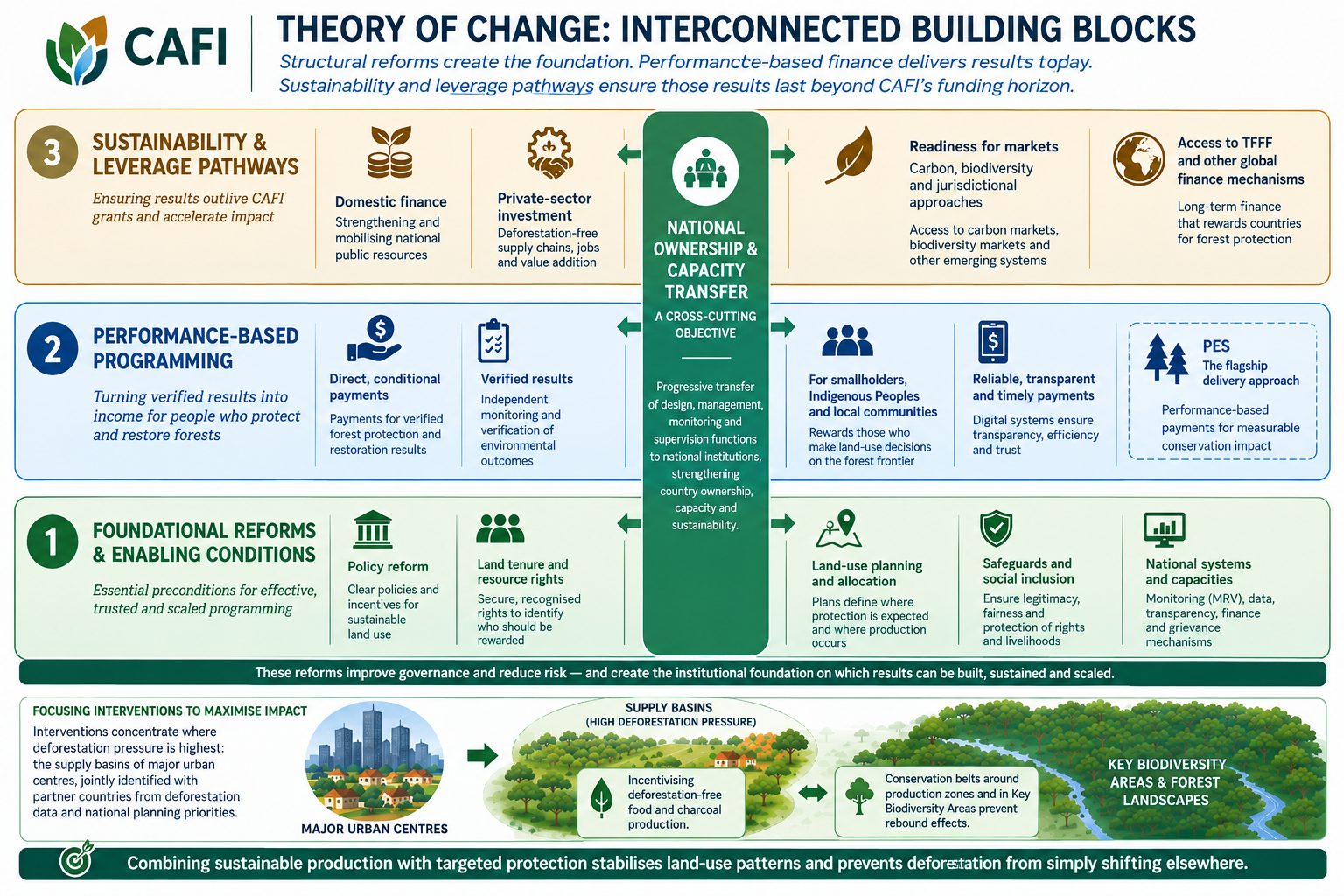
CAFI’s Theory of Change is best pictured as building blocks: structural reforms and enabling conditions form the essential foundation on which performance-based finance grows as an innovative delivery approach alongside continued policy, institutional and enabling-conditions work that remains essential in its own right, while sustainability and leverage pathways carry results beyond CAFI’s own funding horizon. The blocks are interconnected and mutually reinforcing, and their relative weight varies with each country’s priorities and starting point. The balance between the blocks and the pace at which performance-based finance scales will be calibrated in dialogue with partner countries.
- Foundational reforms and enabling conditions: policy reform, land tenure, land-use planning, safeguards and national systems. These reforms improve governance, reduce investment risk, clarify rights, strengthen accountability and support more sustainable land-use decisions. These outcomes are objectives, needed well beyond any single delivery mechanism. At the same time, they are also essential preconditions for effective payments for environmental services. PES can only work where land and resource rights are clear enough to identify who should be rewarded, land-use plans define where forest protection is expected, safeguards ensure legitimacy and fairness, and national monitoring systems can verify results. Coherent land-use allocation, secure tenure and credible monitoring therefore do more than support good forest governance: they create the institutional foundation on which conditional, results-based payments can be targeted, trusted and scaled.
- Innovative delivery approach: performance-based finance, with PES as the flagship. Direct, conditional payments turn verified forest protection and restoration into income for the millions of smallholder farmers, indigenous peoples and local communities who make land-use decisions every day at the forest frontier.
- Sustainability and leverage pathways: domestic finance, private-sector investment, and readiness for carbon markets, and the Tropical Forest Forever Facility (TFFF), which determine whether results outlive CAFI grants.
The blocks reinforce one another: reforms raise the effectiveness and integrity of every dollar of performance finance, while PES creates local constituencies and political demand for further reform; national systems built for PES can be leveraged as the key information infrastructure countries need to access carbon markets and the TFFF; and effective land governance and safeguards ensure that private investment becomes deforestation-free, providing in return the jobs and value chains that reduce pressure on forests as payments taper.
Focusing interventions to maximise impact
To achieve rapid and durable results, interventions are differentiated according to countries’ deforestation dynamics, development priorities and institutional capacities.
In countries where deforestation pressure is concentrated around the supply basins of major urban centres, efforts focus on promoting deforestation-free food and charcoal production, combined with targeted conservation measures to prevent the displacement of deforestation to other areas or rebound effects (the clearing of additional forest as productivity and incomes rise). Combining sustainable production with targeted protection stabilises land-use patterns and prevents deforestation from simply shifting elsewhere.
In High Forest Cover, Low Deforestation (HFLD) countries, interventions place greater emphasis on maintaining standing forests, carbon stocks, biodiversity and ecosystem services, while supporting sustainable development pathways that reduce future risks to forest landscapes.
Across all contexts, priorities are jointly identified with partner countries based on national planning objectives, forest and land-use data, and the specific drivers of deforestation and forest degradation.
This differentiated approach maximises impact while recognising the diverse development trajectories, institutional capacities and forest stewardship challenges across the Congo Basin. It also recognises that performance may mean reducing deforestation where pressures are high, or sustaining low deforestation and high levels of forest integrity where pressures remain relatively limited.
National Ownership and Capacity Transfer: A Cross Cutting Objective
Across CAFI’s work on foundational reforms and enabling conditions, performance-based finance and Sustainability and leverage pathways, a cross-cutting objective will be to progressively transfer design, management, monitoring and supervision functions to national institutions where conditions allow.
National access is not only a financing modality but an investment in long-term institutional capacity, sovereign systems and sustainable management of climate and forest finance.
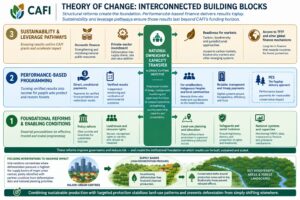
CAFI ToC – Click here to enlarge
4. Building Block 1: Foundational Reforms: agriculture, energy, land tenure and planning policies
One of CAFI’s key success stories, policy reform remains a cornerstone of this strategy. CAFI was the first large-scale initiative to recognise that addressing deforestation goes well beyond forest-sector policy, pioneering an integrated approach that combines agriculture, energy, land tenure, demographic transition and planning policies alongside forest policy.
Through Letters of Intent and high-level political dialogue, CAFI helps partner countries align land-use, agriculture, forest and tenure policies; harmonise donor, international financial institutions (IFIs) and national reform agendas; and create the conditions for sustainable private-sector engagement. In many cases CAFI has supported countries in updating policies that were absent or decades out of date.
These reforms are not abstract: examples include the DRC’s National Land-Use Planning Law, National Agriculture Policy directing expansion toward savannahs and degraded land, National Land Tenure Policy and Sustainable Energy Policy; Gabon’s national directives prohibiting conversion of High Carbon Stock and High Conservation Value forests and its natural-resource observation system; and the Republic of Congo’s national forest MRV system. They unlock finance, reduce risk, and embed forest protection into national development pathways ensuring sustainability beyond individual projects and beyond the forest sector.
What’s next for policy reform
The need for further structural reform varies from country to country. Building on existing Letters of Intent, and acknowledging country priorities, CAFI envisages support to a focused set of strategic reform efforts:
- Readiness for the TFFF, including national forest monitoring data.
- Carbon-finance readiness including Article 6 cooperation, for forest and non-forest activities.
- Clarifying and securing land tenure, to incentivise sustainable land-use management and community-based investment in deforestation-free production systems.
- Targeted business-environment reforms to de-risk commercial investment in deforestation-free value chains and the forest economy.
- The integration of performance-based approaches into relevant public policies with the aim to create the policy, educational and organisational conditions for performance-based programming.
- Institutional reforms that enable increased domestic co-financing and the long-term financial sustainability of PES schemes and other CAFI investments.
- Inclusion of forest conservation and forest economies in long-term development strategies and investment guidelines.
- Support certification, traceability, branding, market access, and policy alignment with international standards and trade regulations for sustainable commodities, while reducing compliance costs and supporting the inclusion of smallholders and communities.
- Strengthening national forest monitoring and MRV systems as core public infrastructure for forest governance through a performance-based approach that promotes data transparency, regular publication of monitoring results, and the timely fulfilment of national and international reporting obligations, matched with domestic financing
- Other policies aiming to fulfil the legitimate development aspirations of the peoples of the Congo Basin while sparing forests.
These initiatives are targeted and fully aligned with CAFI’s core investment framework: they do not introduce new priorities but enhance the financial sustainability and impact of existing workstreams. Leveraging substantial increases in domestic funding, alongside public and private investment, is a key deliverable of this block. It is important to note that many policy reforms retain their own results framework and are pursued for their broader governance and development value, not solely as enablers performance-based finance.
5. Building Block 2: Performance-Based Programming as an Innovative Delivery Mechanism
To turn finance into measurable forest protection and tangible livelihoods at scale, CAFI is shifting the majority of its funding toward performance-based programming: an approach under which finance is disbursed against independently verified results rather than activities. Performance-based programming (PBP) is CAFI’s overall delivery approach which can include various types of performance-linked agreements with implementing partners and institutions financing whereby finance is released against independently verified results.
Payments for environmental services (PES) are the flagship instrument of this approach, alongside other results-based modalities. At the heart of the strategy is CAFI’s PES Program: a standardised, region-wide mechanism co-developed with the governments of the region to deliver direct, performance-based payments to farmers and communities at scale. This shift builds on but does not replace CAFI’s continued investment in reforms and enabling conditions; the balance between instruments will continue to vary by country and will be reviewed with partner countries as evidence accumulates.
Why performance-based programming works
- It corrects a fundamental agency problem: CAFI defines a clear, measurable outcome and pays only per unit of verified result, transferring delivery risk to those best placed to manage it.
- It changes organisational behaviour: when payments depend on results, implementers optimise for outcomes, quickly deprioritising what does not work and scaling what does.
- It fosters cost-effective use of grant finance: attaching an explicit price to a unit of outcome lets CAFI compare cost per result across projects, regions and delivery models, so resources flow to the most effective solutions.
- It generates better information on impact: because payments depend on verified outcomes, evaluation acquires real material value, becoming more credible, systematic and standardised across the portfolio.
Performance-based programming requires an appropriate balance of risks and responsibilities between CAFI, implementing partners, governments, farmers and communities. The allocation of risks will vary depending on country context, institutional maturity and the nature of the intervention. The appropriate financing structure will vary from one intervention to another depending on the different partner’s capacity to prefinance activities, the time required to generate results and the risks beyond the beneficiary’s reasonable control.
Performance based programming : Click here to enlarge
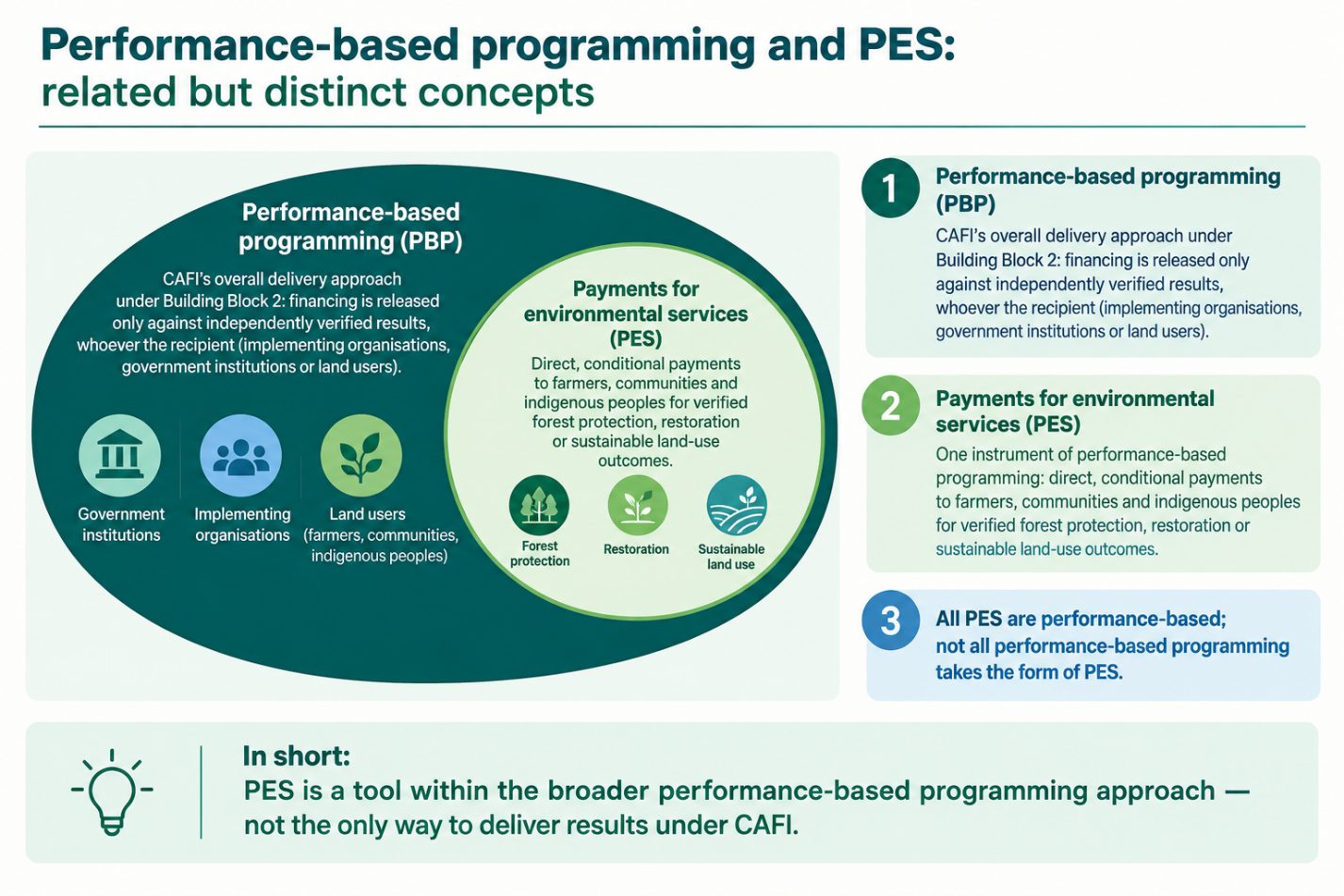
PES, the flagship instrument
Within this approach, payments for environmental services are CAFI’s flagship instrument, alongside other results-based modalities such as performance-linked agreements with implementing partners and institutions. At the heart of the strategy is CAFI’s PES Program: a standardised, region-wide mechanism co-developed with the governments of the region to deliver direct, performance-based payments to farmers and communities at scale.
PES rewards two kinds of results:
- Individual performance: agroforestry, reforestation, natural regeneration, deforestation-free agriculture.
- Collective performance: community forest conservation and management, grounded in inclusive land-use planning.
Payments are made only when results are verified thus ensuring high environmental integrity, transparency for donors, and accountability for governments and communities. Of course, risks that beneficiaries cannot reasonably control, including exceptional climatic events, major price shocks, conflict or delays attributable to public or programme systems, should not be transferred to farmers and communities. Payment arrangements therefore incorporate proportionate provisions for force majeure, exceptional shocks, corrective action and the adjustment of targets where circumstances outside beneficiaries’ control materially affect performance.
Progressive scaling
Scaling follows evidence: models move to scale when their results, costs and risks are demonstrated. Impact evaluation and structured learning are embedded in every programme, so each phase of expansion rests on firmer ground than the last. PES rollout is sequenced with tenure clarification, so payments reinforce rather than distort rights over land. And every programme is designed from day one around a credible answer to who sustains payments after CAFI (domestic budgets, carbon revenues, TFFF flows or market revenues), so that PES does not create permanent aid dependence.
Managing underperformance
Underperformance will trigger a proportionate and graduated response: early detection, joint diagnosis of its causes, a corrective-action plan, targeted technical support, a defined remediation period and renewed verification. Suspension or termination will remain available where underperformance is persistent, attributable to the responsible party and not corrected within the agreed period.
Digital delivery at scale
The PES Program is enabled by a central digital management system: mobile enrolment and smart contracting; monitoring through satellites, maps and geotagged data; risk-based independent verification; and transparent, traceable digital payments. Deployed at scale and designed for low-bandwidth environments, this system dramatically reduces transaction costs and administrative burden, so the programme can grow without proportional increases in staffing or overhead and provides the real-time visibility of results that large-scale climate and biodiversity finance requires. It also creates the conditions for leveraging carbon finance to sustain the system.
Whenever possible, digital systems, registries, monitoring platforms and payment systems supported by CAFI will be interoperable with national systems and governed through arrangements that ensure long-term national ownership, sovereignty over data and sustainability beyond project lifetimes.
Safeguards and inclusion
Indigenous Peoples and local communities are not only beneficiaries of CAFI financing. They are rights holders, forest stewards, governance actors, monitoring partners and economic actors in sustainable forest landscapes. CAFI will support their effective participation in programme design, territorial governance, participatory monitoring, benefit sharing, grievance mechanisms and the development of sustainable economic opportunities.
Programmes will build on legitimate and inclusive national and local institutions wherever appropriate, rather than creating unnecessary parallel community structures. All payment schemes operate under CAFI’s safeguards framework: free, prior and informed consent; verified land rights and participatory zoning; specific measures for the participation and benefit of women, youth and indigenous peoples; functioning grievance mechanisms; and transparent, auditable payment channels.
Participation in a CAFI-supported PES programme will not, by itself, constitute a transfer or waiver of carbon rights or of the right to participate in future carbon-market transactions. Any assignment, authorisation or transfer of environmental attributes must be separately identified, consistent with applicable national law, transparently documented and subject to the free, prior and informed agreement of the relevant rights holders.
South-South Cooperation
CAFI will facilitate South-South cooperation and peer learning among tropical forest countries, including exchanges with countries that have developed advanced experiences in PES with a focus on Brazil and Costa Rica both signatories of the CAFI Declaration as south-south partners.
6. Building Block 3: Sustainability and Leverage, Mobilising All Sources of Finance
This block mirrors the third building block of CAFI’s theory of change: it covers the pathways through which results are sustained, and finance is leveraged beyond CAFI grants through domestic public finance, private-sector investment, and readiness for carbon markets, and the TFFF. In the spirit of the Belém Call to Action, it rests on mutual responsibilities: partner countries progressively embed forest protection in national budgets, policies and institutions, while donors provide predictable support and work to broaden access to new sources of finance.
Domestic finance
Domestic finance is an equally important leverage pathway. CAFI will support partner countries to progressively increase domestic contributions through budget allocations, earmarked levies and in-kind contributions such as land, staff time while recognising that the realistic pace and form of domestic financing differ across countries and must be agreed, not assumed. What can be expected from domestic budgets, and from CAFI donors, over the strategy period will be the subject of a dedicated discussion between the Board and Central African partner countries.
Private Sector finance
Mobilising private-sector finance is essential for CAFI to scale climate and forest investment in Central Africa and to create the jobs, value chains and economic opportunities that sustain forest protection beyond grant funding.
CAFI has a credible track record. Since launching its Private Sector Facility in 2022, it has financed private-sector projects and funds, leveraged additional investor capital, and supported company-led feasibility studies to de-risk innovative business models. These investments generate both commercial returns and measurable environmental outcomes aligned with CAFI’s theory of change and performance framework (several already incorporate PES), and returns are expected to be reinvested in similar high-impact initiatives or returned to the Trust Fund. This strategy builds on and expands that portfolio.
Within this ecosystem, blended-finance vehicles such as the Canopy Trust, the &Green Fund and the ACT Fund play an important role in mobilising and de-risking commercial capital. While these facilities address financial and commercial risks, CAFI focuses on governance, safeguards, PES systems and the enabling conditions that attract and sustain private capital: land-use governance, tenure clarification, FPIC, traceability systems, business-environment reforms, sectoral regulation, rural special economic zones and carbon-market infrastructure. These public investments reduce political and operational risks and ensure investment delivers lasting reductions in deforestation. Together they form a diversified financing architecture capable of scaling deforestation-free development across Central Africa while progressively reducing reliance on traditional ODA.
As the portfolio matures, CAFI will increasingly serve as a platform linking PES programmes, private-sector implementers, investors and commercial off-takers within a landscape approach. Partners contribute complementary strengths, from investment origination and technical assistance to catalytic finance, investment structuring, traceability, safeguards and market access, while CAFI ensures alignment with forest objectives through common standards for safeguards, monitoring, verification and rebound-risk management.
A key element of CAFI’s long-term exit strategy is the gradual replacement of grant-funded environmental payments with demand-driven finance from value-chain actors and other ecosystem-service beneficiaries. Growing corporate net-zero and supply-chain (“insetting”) commitments create opportunities to finance forest conservation, agroforestry and sustainable production in sourcing landscapes. This is especially promising in sectors such as cocoa, where buyers increasingly require traceable, deforestation-free supply chains and where Cameroon and the DRC are becoming important sourcing regions: companies could become significant future buyers of PES and related landscape services. PES and private investment are mutually reinforcing: PES programmes establish sustainable production systems, forest stewardship, traceability and community institutions, while private investment provides the jobs, processing capacity, market access and commercial incentives that sustain these gains beyond donor support. CAFI will strengthen this integration so that successful PES beneficiaries transition into self-sustaining, deforestation-free value chains financed by markets rather than aid.
Carbon markets and the TFFF: prepare actively, rely prudently
Carbon markets, and the TFFF could become significant long-term sources of forest finance for the region, but their timing, prices and volumes remain uncertain. CAFI’s strategy therefore treats them as opportunities to be actively prepared for, never as assumptions on which delivery depends, and attaches no numerical expectations to them at this stage. CAFI’s contribution to readiness runs through all three building blocks:
- PES lays the groundwork for TFFF eligibility (keeping forests standing, reducing deforestation drivers, restoring degraded land) and doubles as the benefit-sharing mechanism through which future TFFF payments can reach forest communities directly, including the required allocations to indigenous peoples and local communities.
- CAFI’s long-standing support to REDD+ readiness (national forest monitoring, strategies and action plans, safeguards information systems and reference levels) maps directly onto TFFF accession requirements; remaining gaps, such as operational grievance redress mechanisms, are priorities for support.
- National access modalities strengthen public financial management and position country systems to channel TFFF resources when they flow.
Sustainability and transition planning
Every CAFI programme will include, from inception, a sustainability and transition plan. This will identify the national or local institution expected to assume each continuing function, the capacities and systems to be transferred, the recurrent costs involved, potential successor financing sources and measurable milestones for the progressive transfer of responsibility.
For PES and other incentive mechanisms, sustainability may combine national financing, responsible private investment, viable forest-compatible value chains and potential future carbon, or TFFF finance. These future sources will be actively prepared for but will not be treated as guaranteed revenue.
7. Cross Cutting: National Ownership and Capacity Transfer
National ownership and capacity transfer is the pathway connecting all three building blocks. CAFI will progressively transfer design, management, monitoring and supervision functions to national institutions where such institutions meet applicable international standards. National access is therefore not only a financing modality, but an investment in national institutions and systems.
Each country programme will identify opportunities for progressively transferring functions, responsibilities, knowledge, equipment and systems to national and subnational institutions. The pace and modality of this transfer will reflect country demand, institutional mandates, demonstrated capacity and applicable fiduciary, environmental and social requirements.
Progress will be assessed not only through environmental and socioeconomic results, but also through the institutional capacity left in partner countries, including strengthened national systems, transferred functions, trained national expertise, interoperable data systems and sustainable arrangements for recurrent domestic and international financing.
8. Expected Results and Value for Money
The strategy carries one binding allocation commitment: at least 50 per cent of CAFI’s resources will flow directly to farmers, communities and indigenous peoples through multiple delivery channels including CAFI’s payment for environmental services. This figure is retained as an ambitious, aspirational anchor because it defines what kind of initiative CAFI seeks to be: one in which the majority of finance reaches the people who protect forests on the ground.
At full ambition, and combining all sources of finance (donor, domestic, private and market-based), CAFI aims by 2035 to mobilise USD 2 billion, reach approximately 8 million direct beneficiaries, and enrol approximately 3 million hectares in PES across the most strategic areas at risk of deforestation.
To achieve these outcomes, CAFI will pursue an adaptive investment strategy that progressively allocates resources across countries, geographies and intervention areas based on emerging evidence, implementation performance and evolving opportunities in terms of cofinance. Resource allocation priorities will be defined through country programmes and Board decisions, allowing the portfolio to respond to changing contexts while maintaining focus on impact.
Investments will combine direct incentives for forest stewardship with the systems and capacities required to sustain results over time. CAFI will therefore support enabling conditions (including participatory land-use planning, FPIC processes, tenure clarification and technical assistance) as well as technological innovation, institutional strengthening and the gradual transfer of operational responsibilities to national partners.
Strategic decision-making will be informed by continuous learning and evidence generation. Quantitative assessments of potential outcomes (including enrolled areas, avoided deforestation, carbon sequestration, employment and economic benefits under different financing scenarios) will be developed through CAFI’s Ground Impact modelling tool and updated periodically. Together with lessons from pilot programmes and implementation experience, these analyses will guide portfolio evolution and investment decisions throughout the strategy period.
9. Risk Analysis and Mitigation
This strategy responds directly to the root cause of deforestation in the Congo Basin (poverty-driven slash-and-burn agriculture) in the hotspots identified through rigorous study and ten years of implementation, and reflects the expressed needs of communities and governments that have already integrated PES into national climate strategies. Risks remain structural features of the operating environment; they are managed openly rather than assumed away.
| Risk | Mitigation |
|---|---|
|
Political instability and institutional weakness |
A decade of engagement across political cycles; work embedded in national frameworks; government and community buy-in; UN Trust Fund host agreements guaranteeing continuity |
|
Connectivity and energy access constraints |
Platform designed for low-bandwidth environments, offline functionality, solar charging, satellite-connectivity partnerships |
|
Land tenure conflict and exclusion of vulnerable groups |
FPIC, verified land rights and participatory zoning; targeted inclusion of women and indigenous peoples; grievance mechanisms; tenure partnerships to speed community enrolment |
|
Under-performance of implementing partners |
Capacity building; sliding-scale performance payments; remediation and contract enforcement; overprogramming; use of established local partners and aggregators |
|
Farmers and communities lack the liquidity or income security required to undertake investments before receiving performance payments. |
Upfront inputs and investment support; savings and finance mechanisms; payment schedules adapted to production cycles. |
|
Performance-based contracts allocate excessive financial or delivery risk to communities, national institutions or implementing partners. |
Explicit risk-allocation frameworks; differentiated responsibilities; force-majeure provisions; corrective-action periods; adjustment mechanisms for external shocks; mixed upfront and ex post financing. |
|
Corruption and leakage |
Full digitalisation, mobile payments and smart contracts ensuring traceability and results-based disbursement; independent audits |
|
Environmental harm, market distortion or phase-out distress |
Automated eligibility checks and spatial verification; satellite monitoring and independent audits; exit pathways and national financing designed in from the start |
|
Rising opportunity costs of keeping forests standing : higher energy prices increasing charcoal demand; expansion of mining and associated roads opening new deforestation fronts |
Periodic reassessment of payment levels against opportunity costs; monitoring of emerging deforestation frontiers with flexibility to redirect conservation belts; policy dialogue on infrastructure, mining and energy planning; investment in sustainable charcoal and alternative-energy value chains |
|
Domestic, carbon-market and TFFF finance does not materialise at the expected scale, prolonging dependence on donor funding |
No delivery assumptions attached to carbon markets or the TFFF; building a robust, independently verified proof of concept at scale to attract additional external public and private funders; dedicated financing dialogue between the Board and partner countries; diversification of funding sources and sustained donor engagement |
10. Resource Mobilisation
Resource mobilisation is joint effort by all parties, led by a task force of donors, partner countries and the Administrative Agent and supported by the Secretariat. It is guided by the following principles:
- CAFI funding is catalytic: it prepares Central African countries to tap bigger, more sustainable resources (carbon finance, private investment, the TFFF) and creates confidence for others to co-finance.
- Progressive and context-specific, growth of domestic resources (financial and in kind) reflecting fiscal realities at a pace and in forms agreed with each partner country, as both a financing source and a marker of national ownership.
- National access to meet international standards and create joint programming that is co-financing
- Diversification of sources: public donors, philanthropy, the private sector, Climate Funds, IFIs, domestic finance and innovative instruments on financial markets.
- Transparency of resource mobilisation efforts and reporting, in line with the Belém Call to Action.
- Demonstration of verified results at scale as CAFI’s strongest mobilisation asset: a robust, empirical proof of concept is what will attract additional external public and private funders beyond the current donor base.
The catalytic effect in practice
Experience under the Cameroon Letter of Intent shows how CAFI funding acts as catalyst, market-shaper and credibility-builder: digital PES systems reduce risk and cost; independent verification creates the trust that attracts corporate climate finance, including insetting-linked PES in agricultural value chains; direct-access modalities strengthen the national institutions without which domestic finance remains limited; mandatory co-financing from government, producers and municipalities (including earmarked export levies) secures real buy-in and long-term funding; and blended-finance structures use grants to crowd in concessional and commercial capital. These principles form a blueprint to be replicated across CAFI countries.
11. The Opportunity: From Aid to Enduring Systems
CAFI is designed as a bridge: from project-based aid to nationally embedded systems; from fragmented finance to pooled, results-based funding; and from international funding to mobilised domestic and private capital. CAFI is a coalition of partners: the Central African Republic, the Democratic Republic of the Congo, Cameroon, the Republic of Congo, Equatorial Guinea and Gabon, together with donors and more than two hundred international and local implementing partners.
Country programmes, agreed with each partner country and approved by the Executive Board, translate this strategy into operations, reflecting national priorities and starting points. The Board oversees implementation through annual public reporting on results and finance, supported by independent verification and evaluation. A mid-term review will deliberately revisit the questions this strategy leaves open: whether evidence supports quantified expectations for carbon markets and the TFFF; and whether the balance across the building blocks, and the pace of PES scaling, should be adjusted.
This is a rare opportunity to invest in a proven platform that turns finance into measurable impact, at scale. Partner countries lead, donors align, implementing organisations deliver, and the communities who are the ultimate stewards of the forest are paid, on time and verifiably, for results the whole world depends on.